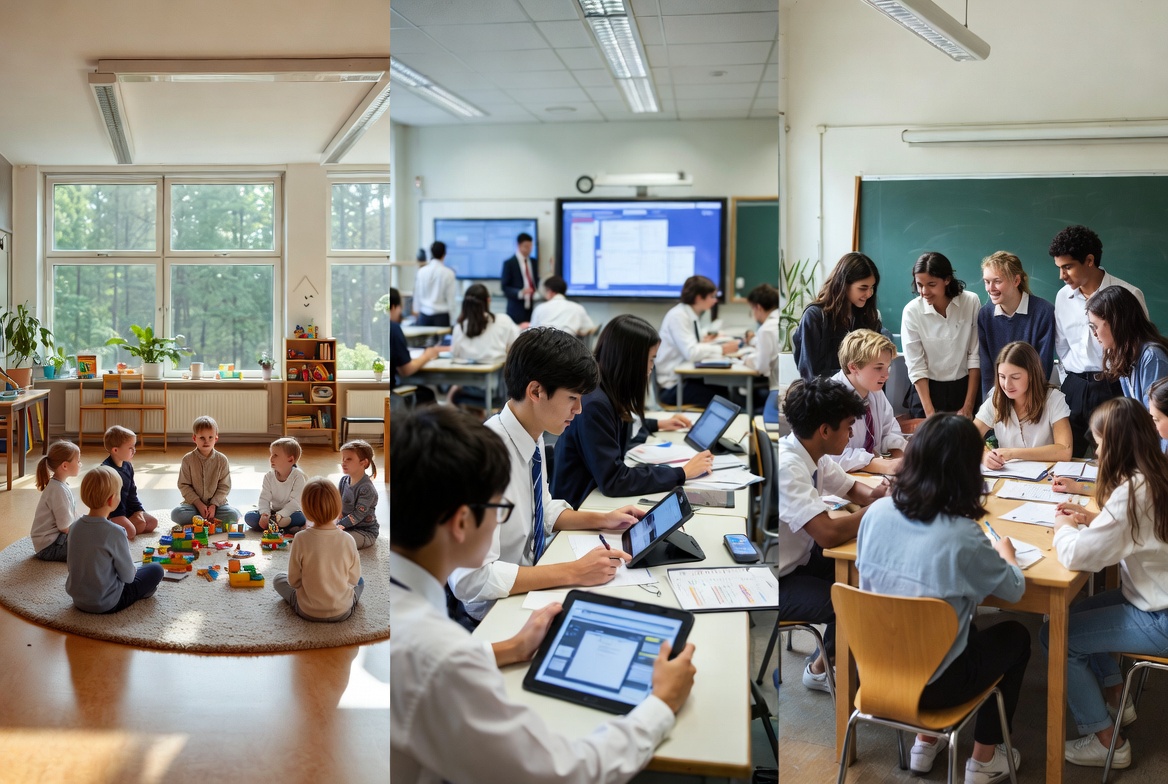
A student in Finland begins their day with unstructured play, spends fewer hours in class than their peers in most other developed nations, and faces almost no standardized testing until they approach graduation. Meanwhile, a student in Singapore navigates a highly competitive environment, with streaming based on academic performance and intense pressure to excel in examinations that determine their educational pathway. Both systems produce high-achieving students, yet they could hardly be more different in their approach. This contrast illustrates a fundamental truth: education is not universal. How we teach and learn reflects our deepest cultural values, our economic priorities, and our beliefs about what children need to become capable adults.
Comparing education across countries reveals the remarkable diversity of approaches to a universal human need. Every society must decide how to pass knowledge to the next generation, how to prepare children for economic participation, how to cultivate citizenship, and how to support individual development. Different societies answer these questions differently, creating educational landscapes that vary dramatically from one nation to another.
Understanding these differences matters for several reasons. For educators, it reveals possibilities that might not be visible within one’s own system. For parents, it offers perspective on choices and pressures their children face. For policymakers, it provides models to consider and cautions about unintended consequences. For students themselves, it fosters appreciation that their educational experience is one of many possible paths to knowledge and competence.
Finland: Equity and Trust
Finland’s education system has attracted global attention for consistently producing excellent outcomes while rejecting many practices common in other high-performing nations. Finnish students spend less time in school, have minimal homework, and face almost no standardized testing, yet they regularly rank among the world’s highest achievers on international assessments.
The foundation of Finnish education is equity. The system is designed to provide every child, regardless of background or location, with the same high-quality education. There are no private schools in Finland; all education is public and free, from early childhood through university. This commitment to equity extends to resources: schools in disadvantaged areas receive more funding than those in affluent areas, ensuring that need rather than wealth determines educational opportunity.
Teachers in Finland enjoy extraordinary autonomy and respect. Teaching is a highly competitive profession, requiring a master’s degree and attracting the brightest university graduates. Once in the classroom, teachers have broad freedom to design curriculum and choose methods based on their professional judgment. The national curriculum provides framework and goals, but teachers decide how to achieve them. This trust in teacher professionalism replaces the accountability mechanisms—standardized testing, performance evaluations, curriculum mandates—that dominate other systems.
The Finnish approach produces students who are not only academically capable but also happy and healthy. Finnish children report high levels of life satisfaction, with education seen as supporting overall well-being rather than merely academic achievement. This holistic approach reflects cultural values that prioritize balance, cooperation, and the intrinsic worth of childhood over competitive achievement.
Singapore: Excellence Through Rigor
Singapore represents a very different model of educational success. Where Finland emphasizes equity and relaxation, Singapore pursues excellence through rigor, competition, and high standards. This small city-state has transformed itself from a poor postcolonial nation into a global economic powerhouse, with education playing a central role in this development.
Singapore’s education system is characterized by streaming, the practice of grouping students by academic ability. Starting in primary school, students are sorted into different tracks based on performance, with pathways diverging toward academic or vocational futures. This system is designed to ensure that every student receives education matched to their abilities and interests, but it also creates intense pressure to perform well on examinations that determine educational futures.
The curriculum in Singapore emphasizes mathematics and science, subjects deemed essential for economic competitiveness. Teaching is highly structured, with detailed syllabi and prescribed methods. Teachers receive extensive training and ongoing professional development, ensuring consistent quality across the system. The result is extraordinary academic achievement: Singaporean students consistently rank at the top of international assessments in mathematics and science.
This success comes with costs. The pressure to excel creates significant stress for students and families. Private tutoring is widespread, with many students spending hours after school in supplementary classes. Critics argue that the system prioritizes academic achievement over creativity, well-being, and holistic development. In response, Singapore has begun reforming its system, reducing streaming and attempting to foster greater creativity and resilience in students.
Germany: Multiple Pathways
Germany’s education system reflects its cultural and economic emphasis on technical excellence and vocational preparation. Rather than assuming that all students should pursue university education, Germany offers multiple pathways that lead to different but equally respected destinations.
The German system includes several types of secondary schools. Gymnasium prepares students for university, offering an academically rigorous curriculum. Realschule provides intermediate education leading to technical and administrative careers. Hauptschule offers vocational preparation for skilled trades. This tracking begins relatively early, with students directed toward different pathways based on academic performance and interests.
Germany’s dual education system represents a distinctive approach to vocational preparation. Students in vocational tracks spend part of their time in school learning theoretical foundations and part in workplaces gaining practical experience. This integration of classroom and workplace learning produces workers who are immediately productive upon completing their education. German apprenticeships are highly respected, and many young people choose vocational pathways that lead to well-paid, secure employment without university degrees.
This system has strengths and limitations. The early tracking has been criticized for limiting social mobility, with children from disadvantaged backgrounds more likely to be directed toward vocational rather than academic pathways. However, the strong vocational system ensures that those who do not attend university still receive high-quality preparation for rewarding careers. The German model demonstrates that excellence in education does not require everyone to follow the same path.
United States: Local Control and Variety
The United States offers a striking contrast to the centralized systems of Finland, Singapore, and Germany. American education is highly decentralized, with authority distributed among federal, state, and local governments, creating enormous variation in educational quality and approach across the country.
The U.S. system is characterized by local control. School districts, often quite small, make many decisions about curriculum, hiring, and spending. This creates diversity: a student in one district might experience very different education from a student in a neighboring district. It also creates inequality: funding often depends on local property taxes, meaning that affluent communities can spend far more per student than poor communities.
American education emphasizes breadth over depth. High school students typically take courses across many subjects rather than specializing early. Extracurricular activities—sports, arts, clubs—play a significant role in American schooling, seen as contributing to well-rounded development. The system also places great weight on standardized testing, particularly for college admissions, creating pressure that shapes much of secondary education.
The strengths of American education include flexibility, diversity of options, and opportunities for innovation. The weaknesses include persistent inequality, inconsistent quality, and sometimes incoherent curriculum. The U.S. system produces extraordinary excellence at its best and troubling failure at its worst, often depending on factors like wealth and geography that should not determine educational opportunity.
Japan: Discipline and Community
Japan’s education system reflects cultural values of discipline, respect, and group harmony. Japanese students learn not only academic subjects but also how to be responsible members of society, with moral education integrated throughout the curriculum.
Japanese schooling emphasizes effort and perseverance over innate ability. The cultural belief that hard work can overcome natural limitations shapes how students are taught and assessed. This creates a strong work ethic but also intense pressure, with students spending long hours in school and supplementary classes preparing for examinations that determine their futures.
The Japanese school year is longer than in many other countries, with shorter breaks and more instructional days. Students take responsibility for maintaining their schools, cleaning classrooms and serving lunch to their peers. This fosters a sense of community and shared responsibility rather than individual entitlement. Group activities and collective goals take precedence over individual expression.
Japanese education produces students with strong foundational skills and discipline, but critics argue that it sometimes sacrifices creativity and critical thinking for conformity and rote learning. Recent reforms have attempted to address these concerns, introducing more flexibility and emphasis on individual expression while maintaining the system’s traditional strengths.
What These Differences Teach Us
Comparing these different systems reveals that there is no single best approach to education. Each system reflects the values, history, and circumstances of its society. What works in Finland might not work in Singapore; what succeeds in Germany might fail in the United States. Context matters enormously in education.
Yet certain principles emerge across successful systems. High-quality teaching matters everywhere, whether teachers enjoy Finnish-style autonomy or Singaporean-style support. Clear standards and expectations help students understand what they need to learn. Support for struggling students prevents early failure from becoming permanent disadvantage. Engagement of families and communities strengthens schools.
The differences also reveal trade-offs that every system must navigate. Equity and excellence can conflict: policies that promote one may undermine the other. Rigor and well-being exist in tension: too much pressure harms students, but too little produces insufficient learning. Standardization and flexibility each have benefits and costs. There are no perfect solutions, only choices that reflect priorities.
For individuals navigating education, whether as students, parents, or educators, understanding these differences offers valuable perspective. It reveals that educational challenges are not unique to one’s own system but represent universal dilemmas that every society must address. It suggests possibilities for improvement by looking at how other systems handle similar challenges. Most importantly, it reminds us that education is always a human creation, shaped by values and choices, capable of being reimagined and reformed.
Conclusion
Education in different countries reveals the remarkable diversity of human approaches to preparing the next generation. From Finland’s trust in teachers to Singapore’s pursuit of excellence, from Germany’s multiple pathways to America’s local variety, from Japan’s community focus to countless other models worldwide, each system represents a particular answer to universal questions about what children need to learn and become.
These differences are not merely academic curiosities. They shape the daily experiences of millions of students, determining how they spend their time, what they learn, how they are assessed, and what opportunities become available to them. They reflect and reinforce cultural values, influencing not just what students know but who they become.
Understanding education across countries offers more than comparative data. It offers perspective on our own assumptions, possibilities we might not have imagined, and humility about the complexity of teaching and learning. It reminds us that education is always a work in progress, shaped by human choices, capable of improvement, and worthy of our most serious attention.
Frequently Asked Questions
Which country has the best education system?
There is no single “best” education system; different systems excel in different ways. Finland produces high achievement with low stress. Singapore achieves top academic results through rigor. Germany provides excellent vocational preparation. The “best” system depends on what values and outcomes you prioritize. International assessments provide useful data but cannot capture everything that matters in education.
Why do education systems differ so much between countries?
Education systems reflect cultural values, historical experiences, economic conditions, and political structures. Countries with strong traditions of social equality design different systems than those emphasizing individual competition. Nations with manufacturing economies may prioritize vocational training differently than those with service economies. Historical experiences, including colonialism and war, shape educational priorities. These factors create the diversity we observe.
Can one country’s education system be copied by another?
Simple copying rarely works because education systems are embedded in their cultural and institutional contexts. Finland’s success depends on Finnish culture and history, not just its policies. However, countries can learn from each other, adapting practices to their own circumstances. The key is understanding why something works in its original context before attempting to transplant it.
How does the United States compare to other countries in education?
The United States shows enormous variation, with some schools and districts that rival the world’s best and others that struggle profoundly. On international assessments, American students typically score above average but below top performers like Singapore and Finland. The U.S. system excels at producing innovation and serves diverse populations, but it struggles with inequality and inconsistent quality.
What can parents learn from different education systems?
Parents can learn that there are many valid approaches to education, that pressure and rigor are not the only paths to success, and that factors like sleep, play, and well-being matter for learning. They can recognize that standardized testing is not universal, that teacher quality matters enormously, and that different children may thrive in different environments. This perspective can inform choices about schools and support for children.
Are international education rankings accurate?
International rankings like PISA provide useful comparative data but have significant limitations. They measure only certain subjects and skills, missing important outcomes like creativity, well-being, and civic engagement. They reflect snapshots in time, not long-term success. They cannot capture the full complexity of educational quality. Rankings are best used as one source of information among many, not as definitive judgments of educational quality.